Winter Solstice in Alaska: The Longest Night and Return of Light
In Alaska, winter light is something people notice. We watch where the sun clears a ridge, how long gold remains on the mountains, and how quickly blue afternoon settles over the snow. By December, daylight has become too precious to take for granted.
The winter solstice in Alaska is the turning point. It brings the shortest period of daylight and the longest night of the year, but it also marks the moment when the trend begins to reverse. The change is small at first—sometimes measured in seconds—but the return of light has begun.
In 2026, the December solstice occurs on Monday, December 21, at 11:50 a.m. Alaska Standard Time. The whole state shares that astronomical moment. What Alaskans experience on the ground, however, varies dramatically with latitude, mountains, weather, and the local horizon.
What causes the winter solstice?
Earth’s axis is tilted about 23.4 degrees relative to its orbit around the sun. As Earth travels around the sun, that tilt changes how directly sunlight reaches each hemisphere. During the December solstice, the Northern Hemisphere is tilted farthest away from the sun. The sun follows its lowest and shortest path across the northern sky, giving us the least daylight of the year.
Winter is not caused by Earth being unusually far from the sun. In fact, Earth is near the closest part of its annual orbit in early January. The seasons come primarily from axial tilt: sunlight arrives at a lower angle in northern winter, spreads over a larger area, and remains above the horizon for fewer hours.
The farther north you travel, the stronger the contrast becomes. That is why “winter solstice in Alaska” does not describe a single daylight experience.
How much daylight does Alaska receive?
On December 21, 2026, published sunrise and sunset calculations show how widely daylight differs across Alaska:
- Juneau: about 6 hours and 22 minutes, with sunrise near 8:44 a.m. and sunset near 3:07 p.m.
- Anchorage: about 5 hours and 28 minutes, with sunrise near 10:13 a.m. and sunset near 3:41 p.m.
- Fairbanks: about 3 hours and 42 minutes, with sunrise near 10:58 a.m. and sunset near 2:39 p.m.
- Utqiaġvik: no sunrise on the solstice because the sun remains below the horizon during its polar night.
These times are calculated for the astronomical horizon and include the effects of atmospheric refraction. A person’s actual view can be different. Mountains, hills, buildings, and clouds may hide direct sunlight even when the sun has technically risen.
That distinction is familiar in Southcentral Alaska. A home tucked below the Chugach Mountains may receive daylight but lose direct sun behind the ridges for weeks. Someone a short drive away with a more open southern horizon may see the sun. Both experiences are real; geography changes how winter light reaches us.
Polar night is not the same as total darkness
Utqiaġvik’s December polar night is often misunderstood. “The sun does not rise” is accurate, but “it is pitch-black all day” is not. The sun stays below the horizon, yet twilight can still brighten the sky for several hours around midday. On December 21, 2026, civil twilight is calculated from roughly 11:56 a.m. to 2:54 p.m.
The result can be a soft band of color rather than ordinary daylight: deep blue overhead, warmer tones near the southern horizon, and snow reflecting whatever light is available. Weather makes a difference, too. A clear sky over snow looks very different from a cloudy day during the same period.
If you want to understand why communities above the Arctic Circle experience such extreme seasonal changes, visit our earlier guide, What Is the Arctic Circle?
The light returns—but not all at once
The solstice is a precise turning point, not an overnight transformation. Daylight begins increasing after December 21, but sunrise may continue getting later for a few days. The U.S. Naval Observatory explains that the shortest day, earliest sunset, and latest sunrise do not normally fall on the same date because clock time and solar time do not move together perfectly.
In Fairbanks in 2026, for example, the earliest sunset is calculated for December 18 and the latest sunrise for December 24. In Juneau, the earliest sunset falls around December 15 and the latest sunrise around December 27. Even after the solstice, the morning can still seem to be losing ground while the total daylight is slowly growing.
At first, the gain may feel almost too small to notice. Then January arrives, and the difference becomes clearer. The afternoon holds on. A familiar trail stays visible a little longer. Sunlight reaches farther across a room. Alaskans begin talking about how much light has returned, because we remember exactly how little there was.
The low sun also changes the quality of the landscape. Instead of climbing high overhead, it skims the southern sky and throws long shadows across snow, spruce, and open water. When clouds and mountains allow it through, the light can turn pale gold or rose. Those short windows are one reason winter photographers and ordinary travelers alike learn to watch the horizon.
Living well through Alaska’s darkest season
Short daylight changes routines, but it does not put Alaska life on hold. Winter brings skiing, snowshoeing, snowmachining, fat-tire biking, sledding, ice fishing, winter train rides, community celebrations, and evenings spent under stars or northern lights.
A few practical habits make the season easier to enjoy:
- Carry a headlamp even for outings that begin in daylight.
- Use reflective clothing or lights when walking near roads.
- Keep extra layers, gloves, and emergency supplies in the vehicle.
- Check weather, trail, ice, and avalanche conditions before heading out.
- Make deliberate use of available daylight, even if it is only a short walk.
Winter also rewards attention indoors. Warm light, shared meals, creative work, and familiar routines give the dark season its own rhythm. Our article Finding God’s Peace in Alaska’s Winter Silence reflects on the quieter side of this season.
A bracelet inspired by Alaska’s winter light
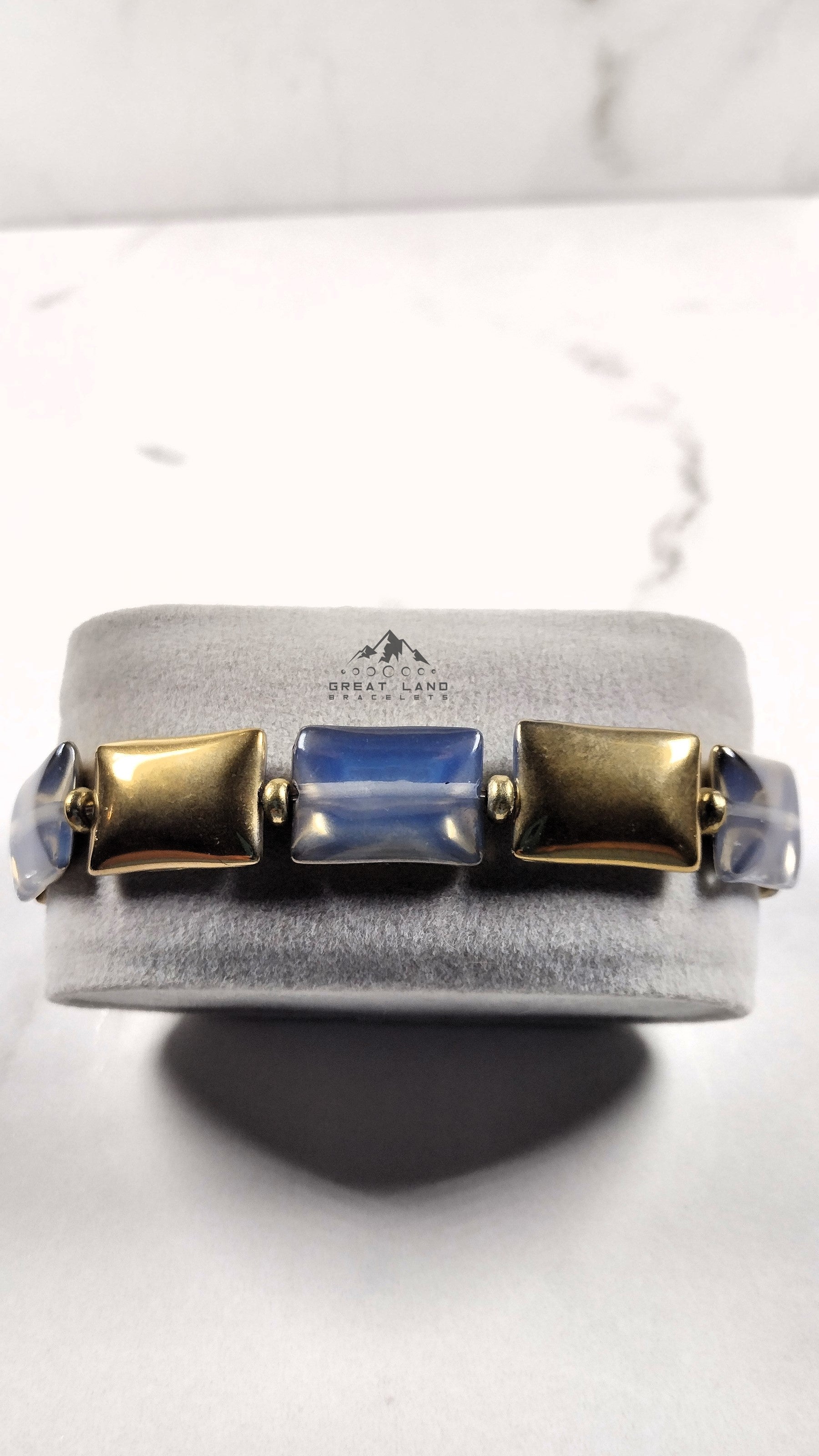
The Alaskan Winter Solstice Bracelet grew from a personal Southcentral Alaska experience: daylight remains, but nearby mountains can block direct sun for part of winter. Its rectangular beads show lighter blue and gold, and brass-colored spacers represent the brief, bright beams of sunlight that make it over the ridges.
The design does not treat winter as colorless. It remembers the pale blue of a low-light sky, the gold of sun on snow, and the warmth people feel when the first direct rays return. It is a stretch bracelet designed to fit most wrists or ankles, with custom sizing available.
That combination of darkness and light is part of what makes the Alaska solstice meaningful. It is the year’s longest night, but it is also a promise written into the calendar: from here, the days grow longer.
To Wear your Alaska™ is to carry those lived moments with you—the winter horizon, the mountain shadow, the first beam over the ridge, and the quiet certainty that light is returning.
Sources and further reading
- NASA: Winter and Summer Solstice
- U.S. Naval Observatory: Sunrise and Sunset Times Near the Solstices
- Anchorage sunrise and sunset times for December 2026
- Fairbanks sunrise and sunset times for December 2026
- Juneau sunrise and sunset times for December 2026
- Utqiaġvik sunrise, sunset, and twilight times for December 2026
-
Posted in
Alaska, Alaska daylight, Alaska winter, Alaskan Winter Solstice Bracelet, Arctic Alaska, Wear your Alaska, Winter solstice in Alaska