Alaska Evergreen Trees: The Green That Holds Through Winter

By October, Alaska has already begun trading its brightest colors for a quieter palette. Birch leaves have fallen from many branches. Fireweed stalks have gone to seed. Fresh snow starts tracing the mountains. Yet across much of the state, one color remains: the steady green of spruce, hemlock, and cedar.
Alaska evergreen trees are more than winter scenery. They shape two very different forest worlds—the boreal forest of the Interior and Southcentral Alaska, and the coastal temperate rainforest of Southeast. Their needles, cones, bark, and branches tell stories about cold, rain, fire, wildlife, and patience. When the days shorten, these trees remind us that a landscape can look still without standing still.
What makes an evergreen “evergreen”?
“Evergreen” does not mean that a tree keeps every needle forever. It means the tree retains living foliage through more than one growing season instead of dropping all its leaves at once each autumn. Old needles still fall, but they are replaced gradually, so the branches remain green year-round.
That strategy matters in northern country. Alaska’s growing season can be brief, and making a whole new canopy every spring takes time and energy. The Alaska Department of Fish and Game notes that black and white spruce retain waxy, drought- and frost-resistant needles throughout the year. That lets them begin photosynthesis earlier in spring and continue later into fall than deciduous neighbors such as birch and aspen.
The familiar cone shape of many conifers is useful, too. Sloping branches can shed some snow instead of holding every inch of it. Flexible boughs bend under a load and often rise again after the snow drops away. Those adaptations do not make an evergreen invulnerable—wind, heavy wet snow, insects, disease, drought, and fire still leave their marks—but they help explain why green branches remain such a dependable part of Alaska winter.
Interior Alaska: black spruce and white spruce
Across Interior Alaska, the boreal forest, or taiga, stretches in a broad mosaic rather than one unbroken wall of trees. Spruce stands alternate with birch and aspen groves, ponds, muskeg, river corridors, shrublands, and open tundra. Black spruce and white spruce are the most common conifers in this region, but they often reveal different things about the ground beneath them.
White spruce generally does best on better-drained sites, including many river terraces and south-facing slopes. It can grow tall and full where soil, warmth, and nutrients cooperate. Black spruce is often the leaner silhouette: narrow, dark, and sometimes widely spaced across cold or poorly drained ground. In areas influenced by permafrost, its roots may remain close to the surface because frozen soil limits drainage and rooting depth.
A sparse black spruce forest can look fragile, but it belongs to a landscape shaped by disturbance. Fire is a natural part of the boreal ecosystem. Black spruce cones are often sealed partly by resin, and heat can help release their seeds. After a burn, the forest does not simply “return” in one step. Grasses, wildflowers, shrubs, deciduous trees, and spruce take their turns in a long cycle of renewal.
That cycle is one reason Alaska evergreens symbolize more than permanence. They also represent adaptation. The forest that endures is not necessarily the forest that never changes; it is the forest that keeps responding to change.
Southeast Alaska: a rainforest of conifers
Travel south and east, and the evergreen story changes. Southeast Alaska lies within a cool coastal temperate rainforest, where ocean moisture, steep mountains, islands, and deep fjords create a world very different from the Interior taiga. The Tongass National Forest covers nearly 17 million acres, and its low-elevation forests are strongly associated with western hemlock and Sitka spruce. Mountain hemlock appears more often at higher elevations, while Alaska yellow-cedar is another characteristic conifer in parts of the region.
Sitka spruce is Alaska’s official state tree. Along the coast, it can reach impressive size, especially on productive, well-drained sites. Western hemlock often grows beside it, contributing to the layered, shadowed character of the forest. Beneath the canopy, mosses soften fallen logs and berries, ferns, salmonberry, and devil’s club fill the understory.
This is not a silent green backdrop. Coastal forests help hold soil, filter water, store carbon, and provide habitat for birds and mammals. Streamside vegetation contributes shade and bank stability along waterways used by salmon. From the crown of a Sitka spruce to the moss on a decaying nurse log, the forest works in layers.
If you enjoyed our look at Girdwood’s meeting of rainforest and mountains, these Southeast forests offer another reminder that “Alaska forest” can mean far more than one kind of place.
Why the green feels brighter in winter
Evergreens are not Alaska’s only winter color. There is blue in glacier ice, rose in alpenglow, silver in willow stems, gold in dry grass, and every shade of gray in rock, cloud, and sea. Still, green catches the eye once deciduous leaves are gone. A snow-covered spruce with a few dark boughs showing can feel like a small promise written into the landscape.
That feeling is especially strong during the months when daylight is limited. The tree has not escaped winter; it is carrying winter. Snow settles on its branches. Wind moves through its needles. Temperatures fall, and the living tissue slows. The green remains—not as proof that nothing has changed, but as evidence that life has prepared for the season.
Alaska paper birch offers a beautiful contrast. Its leaves make autumn luminous before the branches go bare, while spruce keeps a quieter color through the cold. Together they tell a fuller seasonal story. You can explore that contrast in Alaska Paper Birch: The Golden Signature of Fall.
Notice the forest without taking from it
One of the best ways to know an evergreen forest is to slow down. Look at how needles attach to a twig. Notice whether cones hang down or sit upright, whether bark is smooth or scaly, and whether the ground is dry, mossy, frozen, or wet. Listen for wind high in the canopy and for birds moving through the branches.
Leave living boughs, cones, bark, and seedlings where they are unless you have clear permission to gather. Regulations differ among parks, forests, state lands, and private property. A photograph, field note, or simple memory is usually the best souvenir—and it leaves the forest intact for the next person and the next season.
Carry a little evergreen color with you
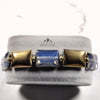
The Essential Evergreen Set was designed around those lasting Alaska greens. Green Line Jasper frames a center lava-stone disc, while Prehnite completes the circle. Bracelet, necklace, and set options echo the shades you might notice where spruce shadows meet moss, lichen, and new growth.
The lava disc can also hold a small drop of a favorite scented oil. Because oils vary, follow the maker’s directions and take appropriate care around skin, clothing, children, and pets. The meaning of the piece does not depend on a fragrance, of course. Its deeper connection is visual: green that stays present through a demanding season.
That is what it means to Wear your Alaska™—not merely to wear a place name, but to carry a story of landscape, memory, and resilience. Whether your Alaska is a black spruce bog under a pale winter sky, a giant Sitka spruce beside salt water, or a single green bough showing through fresh snow, the evergreen forest offers a quiet lesson: endurance can be alive, flexible, and always becoming.
Learn more about Alaska’s forests
-
Posted in
Alaska, Alaska evergreen trees, Alaska forests, Alaska winter, Boreal forest, Essential Evergreen Set, Sitka spruce, Wear your Alaska